AI Receptionist vs Live Answering Service: What Contractors Actually Need to Know
AI receptionists cost $199–$299 per month flat, answer in under 2 seconds, and book directly into your CRM 24/7. Live answering services cost $300–$800+ per month with per-minute billing, take messages rather than booking, and have inconsistent quality. For trade contractors, AI answering delivers 3–5× the ROI of live answering services.
TL;DR: Live answering services put callers on hold for 30–60 seconds and take messages. AI receptionists answer in under 2 rings, book jobs directly, and cost less. For trade contractors handling emergency calls, hold time is revenue lost.
The debate between AI and live answering services often gets framed as a technology question — new vs. traditional, automated vs. human. But for contractors, the more useful frame is operational: which approach actually delivers a booked job, and which one delivers a message that still requires work?
How Each One Actually Works
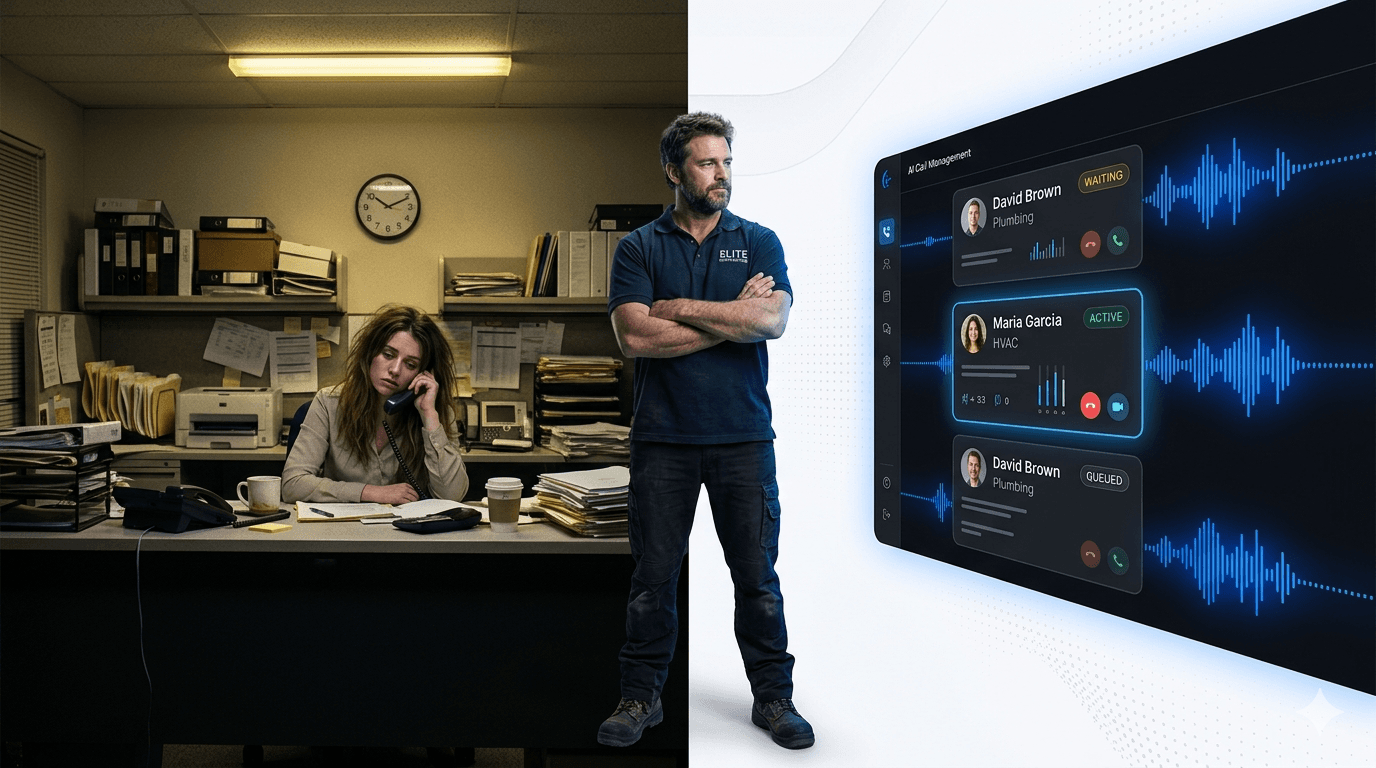
When a customer calls a business using a live answering service, a human operator — typically handling calls for dozens of different businesses simultaneously — answers with your business name, follows a script, collects a name and phone number, takes a message, and sends it to you. That's the end of their involvement. Your team then has to call the customer back, hopefully within the hour, find out what they need, and book the job — assuming the customer still picks up and hasn't already booked with someone who answered faster.
When a customer calls a business using an AI receptionist, the AI answers immediately — with zero hold time, regardless of whether five other calls are coming in simultaneously. It identifies itself as an AI, asks the right intake questions specific to your business, checks your real-time scheduling availability, and books the appointment directly into your field service software. The customer gets a confirmation SMS. You get a booked job in your calendar. No callback required.
Where Live Answering Services Fall Short for Contractors
Live answering services have real limitations that matter specifically for trades businesses:
- They don't know your business. An operator handling 40 client businesses simultaneously doesn't know your service area, your emergency criteria, your pricing, or your scheduling constraints. They follow a basic script. Anything outside that script produces an "I'll have someone call you back."
- They can't book into your CRM. The job isn't booked until your team calls back and enters it. That callback gap — even if it's 20 minutes — is enough for a motivated customer to have already confirmed with a competitor.
- They have capacity limits. During a heat wave or a storm surge, call volume for contractors can triple overnight. A live service with a fixed operator pool gets overwhelmed. Customers get placed on hold or reach voicemail anyway — defeating the purpose of having the service.
- Per-minute billing compounds during complex calls. HVAC and plumbing calls routinely run 4–6 minutes for emergency intake. At $1.25/minute, that's $5–$7.50 per call, before monthly fees. During a busy month, this adds up to a number that's hard to predict and harder to justify.
Where AI Receptionists Have Limits
AI is not perfect for every call type. Calls that involve nuanced negotiation — a customer arguing about a quote, a complex warranty dispute, or a situation that requires genuine judgment about an unusual problem — are better served by a human. The best AI implementations are built with clear fallbacks: the AI handles what it handles well, and warm-transfers to a human for anything outside that scope.
The practical reality for most residential contractors is that 80 to 90% of inbound calls are standard intake and booking calls. Emergency triage, service scheduling, appointment confirmation, and basic FAQs. AI handles all of these with higher consistency than a live operator who is simultaneously handling other clients' calls.
The Callback Conversion Problem
The most underappreciated cost of live answering services is callback conversion. When your team calls back a message lead, you're competing against time. The customer who called about their AC at 3 PM and received a callback at 4:45 PM may already be booked with the competitor who answered at 3:01 PM. Industry data consistently shows that callback conversion rates drop significantly with each passing hour — and that contacting a lead within 5 minutes versus 30 minutes produces dramatically different results.
An AI that books the job in real time during the original call eliminates the callback problem entirely. The customer called, spoke to your "business," got their appointment confirmed, received a text, and is no longer considering your competitors. The entire lead-to-booking cycle happened in one conversation.
See how HulloDesk handles your call types — try free for 14 days →
How to get started
Follow these clear steps to implement this strategy in your business today.
Map your call types
List the top 5 reasons customers call your business. For most contractors, 80%+ of calls are booking requests, service inquiries, or appointment confirmations. AI handles all of these better than live answering.
Identify your true after-hours call volume
Pull your call log and filter for calls after 5 PM and on weekends. For most contractors, this represents 25–40% of total call volume — and it's almost entirely going to voicemail or an expensive live service.
Run both for 30 days
If you're unsure, run an AI service for 30 days and track booking rate vs. your previous answering setup. The data will be unambiguous.
Frequently Asked Questions
Q:What is the main functional difference between AI and live answering for contractors?
Q:Are there situations where a live answering service is better than AI?
Q:What happens when an AI can't answer a question?
The AI Front Office Setup Checklist
Stop losing jobs to missed calls. Get the 4-step checklist we use to set up 24/7 AI receptionists for $1M+ trade businesses.
No spam · Instant PDF delivery · Unsubscribe anytime

Prajwal Kumar is the founder of HulloDesk and an expert in AI voice automation for the trades. He built HulloDesk after watching skilled contractors lose jobs to competitors who simply answered the phone faster. He writes about AI, lead conversion, and practical growth systems for HVAC, plumbing, electrical, and home service businesses.
View all insights by Prajwal

